
Research
My research develops scalable modeling, optimization, and control methods for future energy and transport systems under increasing electrification and renewable integration. I focus on the interaction between distribution grids, electric vehicles, distributed energy resources, and demand-side flexibility.
A central goal of my work is to bridge detailed distribution-grid physics with large-scale energy and transport system models. This requires computational methods that remain physically meaningful while scaling to regional or national analyses.
Vision
Electrification is transforming energy and transport systems. Electric vehicles, rooftop photovoltaics, batteries, heat pumps, and flexible demand are increasingly connected at the distribution level, where grid constraints are often local, data availability is limited, and planning tools remain underdeveloped.
My long-term vision is to develop integrated modeling frameworks that connect local infrastructure constraints with system-level planning. These tools can help identify where electrification creates grid challenges, evaluate flexibility strategies, and support cost-effective decarbonization.
Scalable modeling of distribution grids
Distribution networks are becoming a critical bottleneck in the energy transition, but detailed grid data is often unavailable due to confidentiality and security constraints. My work develops synthetic distribution-grid models using geospatial data, population statistics, building information, demand profiles, and distributed energy resources.
These models enable large-scale studies of electrification scenarios, including electric-vehicle charging, rooftop solar generation, batteries, and heat pumps.
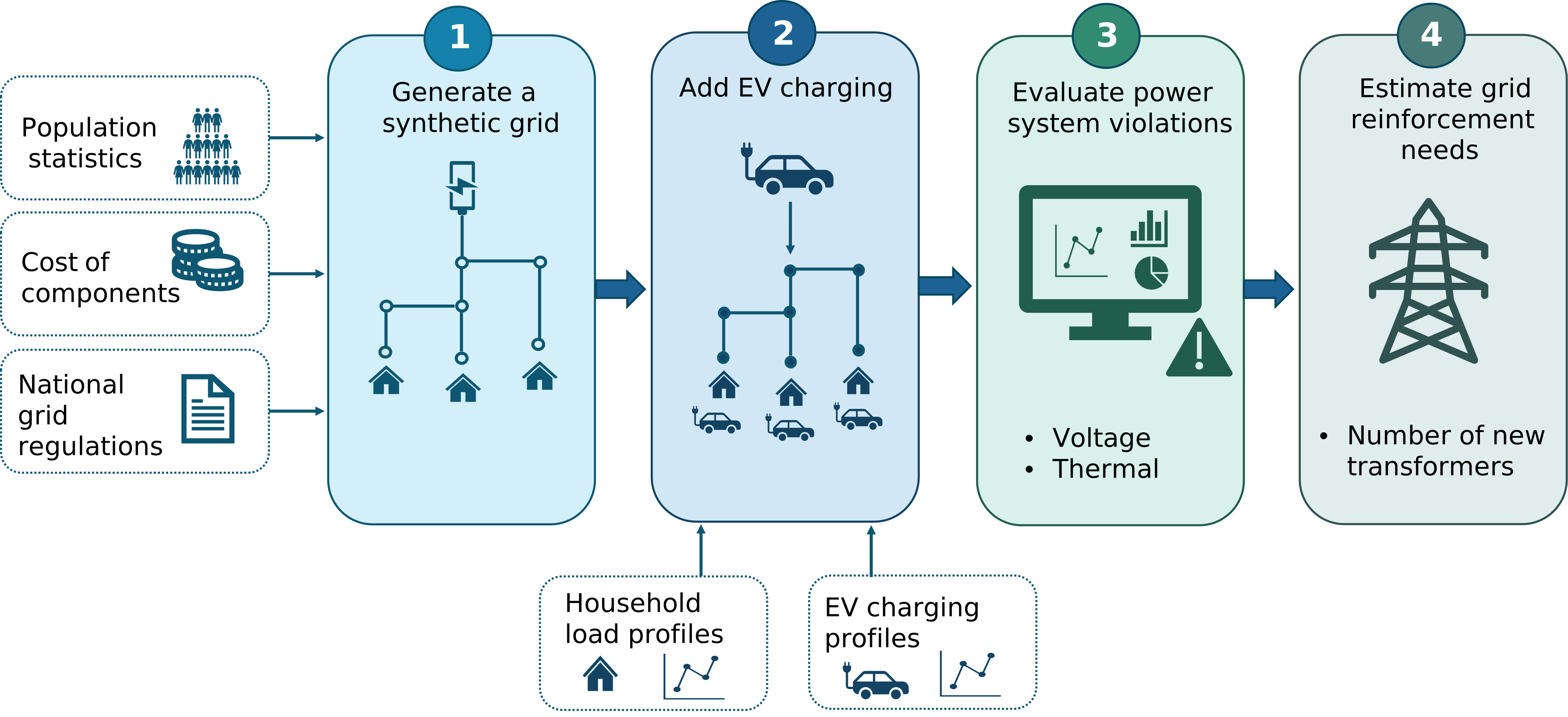
Figure: Schematic illustration of the synthetic low-voltage grid model used to study fleet electrification scenarios.
Flexibility in electrified energy systems
I study how flexible resources can support grid operation and reduce the need for traditional infrastructure reinforcement. This includes electric vehicles, distributed photovoltaics, battery storage, heat pumps, and demand response.
I am particularly interested in how pricing mechanisms, network tariffs, and user behavior can influence demand patterns and improve system performance.
Transport-energy system integration
Transport electrification creates new interactions between mobility systems and electricity infrastructure. My research investigates how electric-vehicle charging, mobility-on-demand services, and shared fleets can be coordinated with power-system constraints and renewable generation.
This includes optimization-based charging, renewable-based ride-sharing, and future mobility systems that integrate routing, charging, and grid-aware decision-making.
Optimization and control for distributed systems
My work uses optimization, control theory, and power-system simulation to design methods for operating distributed energy systems. Recent examples include Volt/Var control for distribution networks with high photovoltaic penetration and coordinated EV charging strategies that align mobility demand with renewable electricity supply.
Background
My background is in theoretical physics, where I developed expertise in mathematical modeling and computational methods. During my PhD, I studied the electromagnetic properties of hyperons to investigate the structure of baryonic matter.
I now apply this foundation to energy and transport systems, with the goal of developing computational tools for complex infrastructure systems undergoing rapid decarbonization.
Prospective students and collaborators
I am interested in working with students and collaborators at the intersection of energy systems, transport systems, optimization, data-driven modeling, and applied mathematics.
Current topics include synthetic distribution grid modeling, EV charging flexibility, network tariff design, and distributed energy resources.